 Add to Chrome
 Add to Firefox
 Add to Edge
Scaling Monosemanticity: Extracting Interpretable Features from Claude 3 Sonnet
May 28, 2026
We demonstrate that sparse autoencoders can extract interpretable features from Claude 3 Sonnet, a production-scale language model, addressing the open question of whether dictionary learning methods scale beyond small transformers. We trained sparse autoencoders with up to 34 million features on the model's middle layer residual stream, using scaling laws to guide hyperparameter selection. The resulting features are multilingual and multimodal (generalizing to images despite text-only training), respond to both concrete instances and abstract discussions of concepts, and can be used to steer model behavior in ways consistent with their interpretations. We find features corresponding to famous entities and locations, as well as more abstract concepts like sarcasm or errors in code. We also identify features relevant to ways in which language models might cause harm--including features representing deception, power-seeking, sycophancy, and bias--and show that these causally influence model outputs when manipulated. Additionally, we conduct analyses of feature interpretability, geometry, and computational function. However, significant limitations remain: our suite of features is incomplete, and we lack rigorous methods for evaluating whether our features faithfully capture model computations.

SAEBench: A Comprehensive Benchmark for Sparse Autoencoders in Language Model Interpretability
Mar 13, 2025Sparse autoencoders (SAEs) are a popular technique for interpreting language model activations, and there is extensive recent work on improving SAE effectiveness. However, most prior work evaluates progress using unsupervised proxy metrics with unclear practical relevance. We introduce SAEBench, a comprehensive evaluation suite that measures SAE performance across seven diverse metrics, spanning interpretability, feature disentanglement and practical applications like unlearning. To enable systematic comparison, we open-source a suite of over 200 SAEs across eight recently proposed SAE architectures and training algorithms. Our evaluation reveals that gains on proxy metrics do not reliably translate to better practical performance. For instance, while Matryoshka SAEs slightly underperform on existing proxy metrics, they substantially outperform other architectures on feature disentanglement metrics; moreover, this advantage grows with SAE scale. By providing a standardized framework for measuring progress in SAE development, SAEBench enables researchers to study scaling trends and make nuanced comparisons between different SAE architectures and training methodologies. Our interactive interface enables researchers to flexibly visualize relationships between metrics across hundreds of open-source SAEs at: https://saebench.xyz
Copy Suppression: Comprehensively Understanding an Attention Head
Oct 06, 2023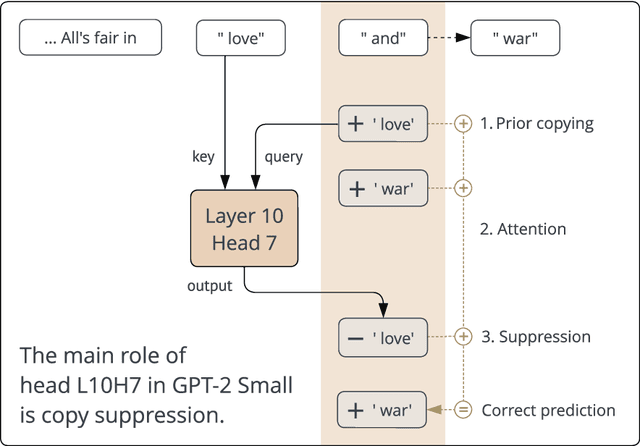
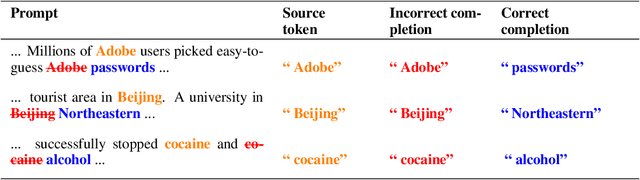
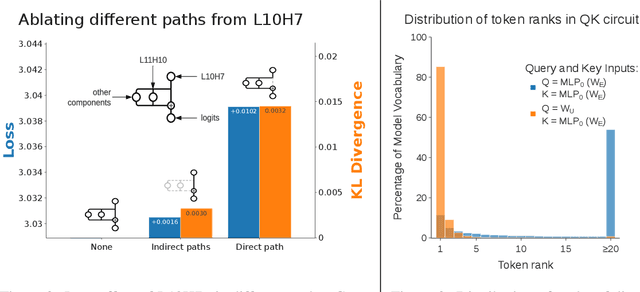
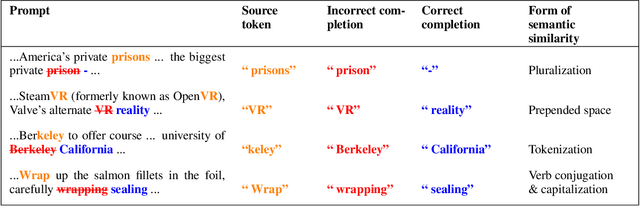
We present a single attention head in GPT-2 Small that has one main role across the entire training distribution. If components in earlier layers predict a certain token, and this token appears earlier in the context, the head suppresses it: we call this copy suppression. Attention Head 10.7 (L10H7) suppresses naive copying behavior which improves overall model calibration. This explains why multiple prior works studying certain narrow tasks found negative heads that systematically favored the wrong answer. We uncover the mechanism that the Negative Heads use for copy suppression with weights-based evidence and are able to explain 76.9% of the impact of L10H7 in GPT-2 Small. To the best of our knowledge, this is the most comprehensive description of the complete role of a component in a language model to date. One major effect of copy suppression is its role in self-repair. Self-repair refers to how ablating crucial model components results in downstream neural network parts compensating for this ablation. Copy suppression leads to self-repair: if an initial overconfident copier is ablated, then there is nothing to suppress. We show that self-repair is implemented by several mechanisms, one of which is copy suppression, which explains 39% of the behavior in a narrow task. Interactive visualisations of the copy suppression phenomena may be seen at our web app https://copy-suppression.streamlit.app/